Planetensuche Astronomy Software
Planetensuche is a comprehensive, free desktop application designed for amateur astronomers, space enthusiasts, and researchers. It integrates vast astronomical databases with powerful visual exploration tools, interactive sky maps, and realistic orbital simulations.
Core Features & Modules
🪐 Exoplanet & Stellar Catalog Database
- Vast Catalogs: Embedded database with up-to-date exoplanet discoveries (NASA Exoplanet Archive, Gaia DR3, TESS TOI/CTOI, Kepler, SIMBAD).
- Broad Scope: Explore exoplanets, galaxies, dwarf planets, asteroids, and variable stars (AAVSO, VSX).
- Habitability Analysis: Calculate Earth Similarity Index (ESI) and filter by circumstellar habitable zones (Kopparapu 2013 models).
- Binary Star Matching: Cross-reference catalog data to identify binary and multiple stellar systems.
📊 Data Visualization & Analytics
- Over 70 Interactive Charts: Compare planetary masses, radii, orbital periods, discovery methods, and stellar spectral types (including HR Diagrams).
- Estimation Tools: Built-in calculators for estimating stellar radius and mass based on observational parameters.
- Lightcurve Import: Plot and analyze transit dips directly from TESS and Kepler photometry data.
🌌 Interactive Star Map & Simulations
- Dynamic Sky Map: Interactive celestial map highlighting constellations, deep-sky objects, and exoplanet host stars.
- Orbit Simulator: Observe exoplanets in realistic orbits around their host stars or build custom planetary configurations.
- Observing Planner: Tracks sunrise/sunset, moon phases, comets, and night sky quality (Bortle & SQM metrics).
🎓 Education & Extras
- Astronomy Quiz: Test your knowledge about space, distances, and planetary facts with a built-in educational quiz module.
- Formula Collection: A handy reference section for common astronomical formulas and physical calculations.
- History of Exoplanet Hunting: Detailed timelines and information regarding milestones in exoplanet research (View timeline →).
⚙️ Technical Architecture
- Offline First: Fully standalone execution at the telescope without requiring internet connectivity.
- Modern Java: Built with Java 21 (LTS) & JavaFX for responsive performance and fluid rendering.
- Cross-Platform: Runs smoothly across Windows, Linux, and macOS.
- Multilingual UI: Supports German, English, French, Spanish, and Italian.
🖼️ Software Screenshots & Interfaces (English)
10 Screenshots1. Main Program & Dashboard
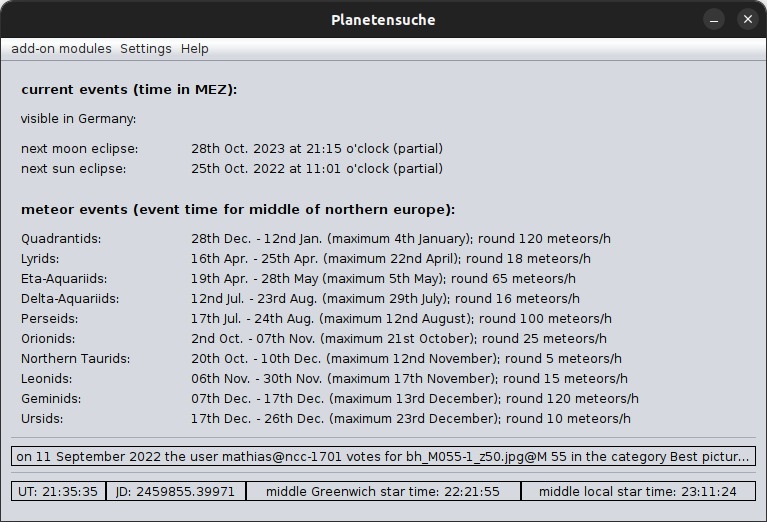
Central user interface with direct access to search modules, tools, and system stats.
2. Exoplanet & Stellar Database
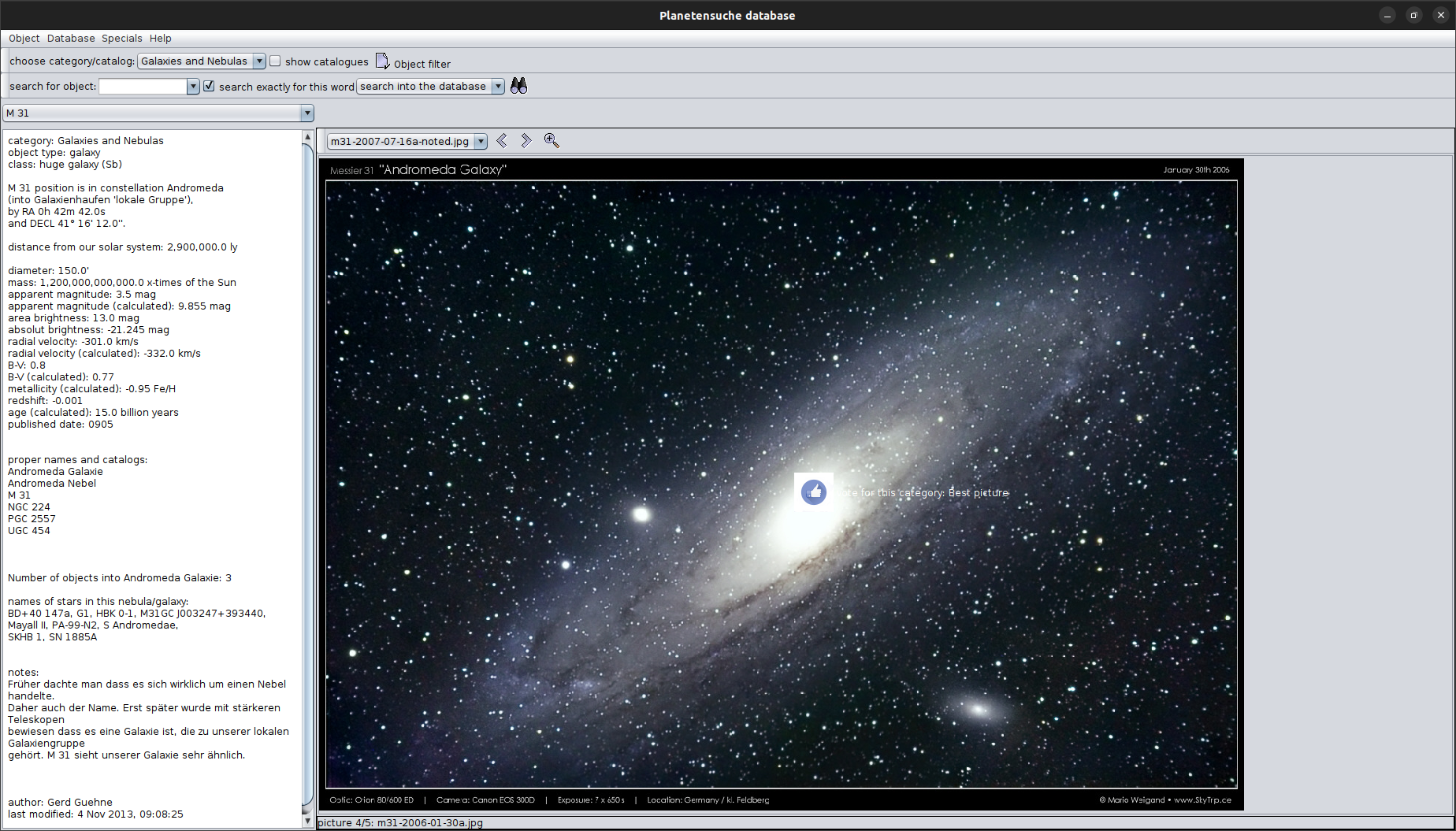
Tabular database view of thousands of exoplanets with advanced filtering and detailed parameters.
3. Double Star & Transit Analysis

Analysis tool to distinguish genuine exoplanet transits from eclipsing binary stars.
4. Gaia DR2 / DR3 Catalog Query

Direct query and cross-matching of stellar properties from ESA Gaia astrometry archive.
5. Hertzsprung-Russell Diagram (HRD)
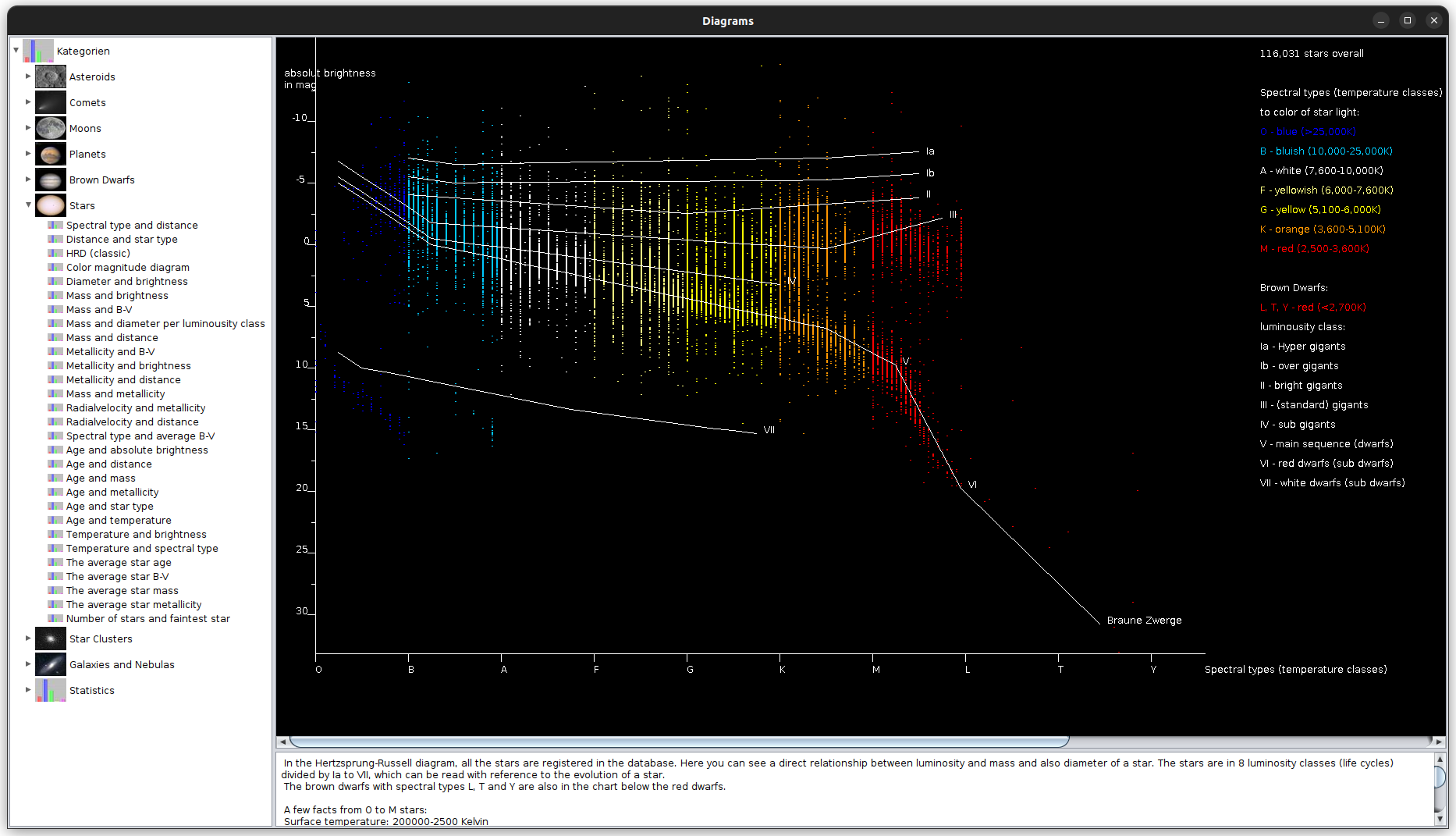
Interactive HR diagram classifying spectral types and luminosity classes of host stars.
6. Exoplanet Projects Overview
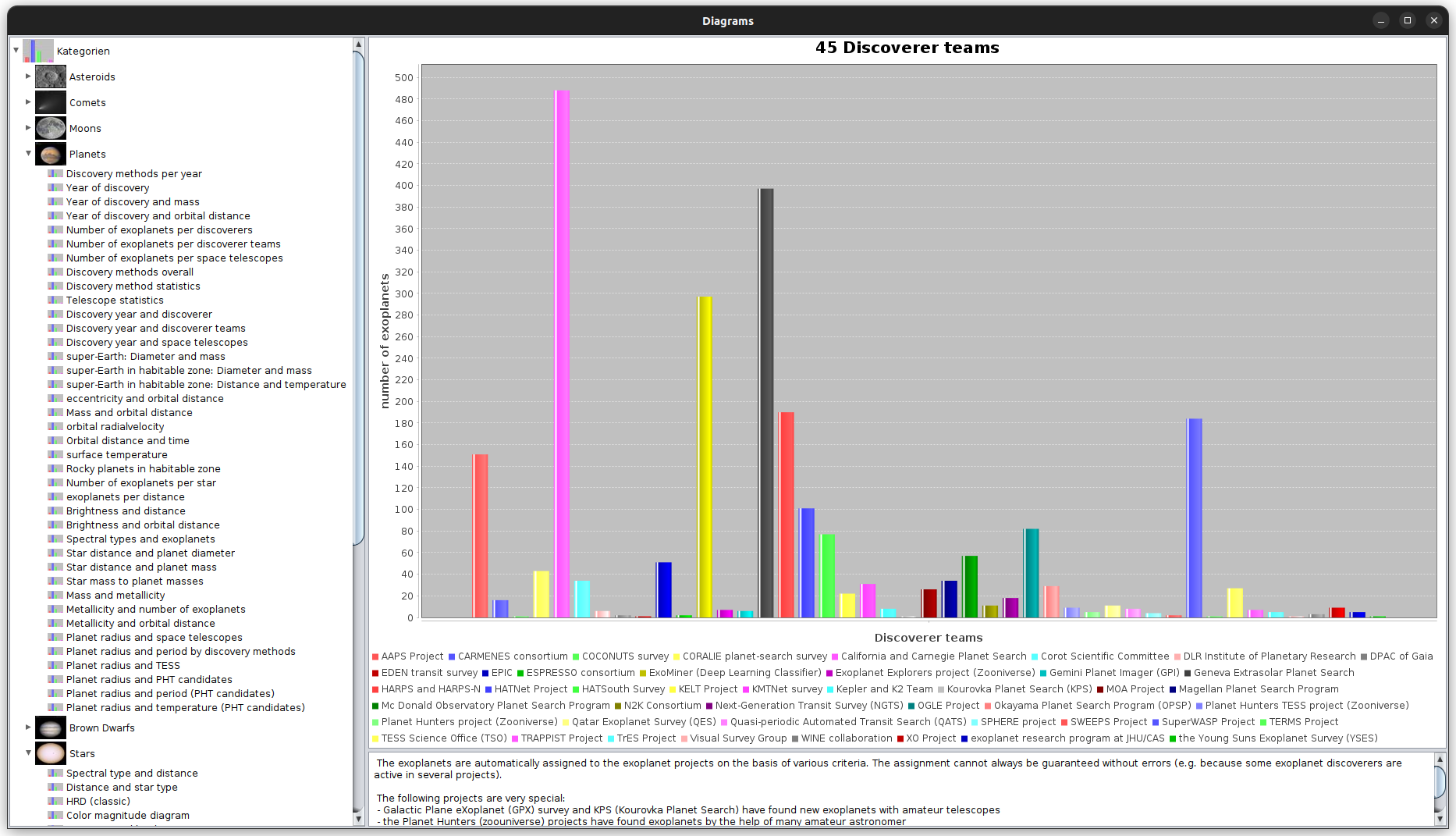
Overview and analysis of dedicated exoplanet search projects such as California and Carnegie Planet Search, Planet Hunters TESS (PHT), SuperWASP, SWEEPS project, Geneva Extrasolar Planet Search, KELT project, and more.
7. Planets in the Milky Way
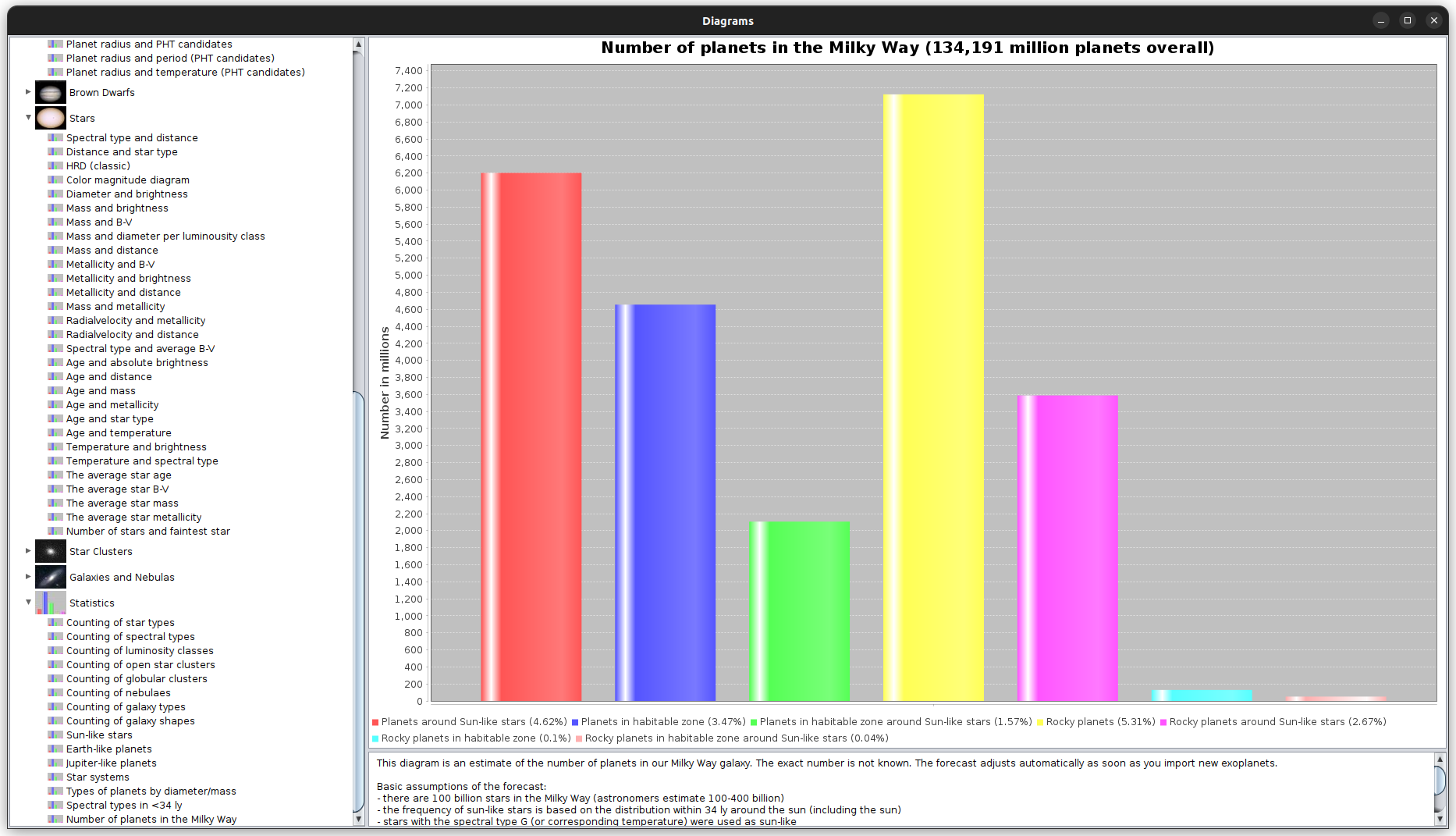
Extrapolation projecting the total population of potentially habitable rocky worlds in our galaxy.
8. Earth Similarity Index (ESI) Analysis

Calculates Earth similarity metrics based on planetary radius, mass, and equilibrium temperature.
9. Exoplanetary System 55 Cancri
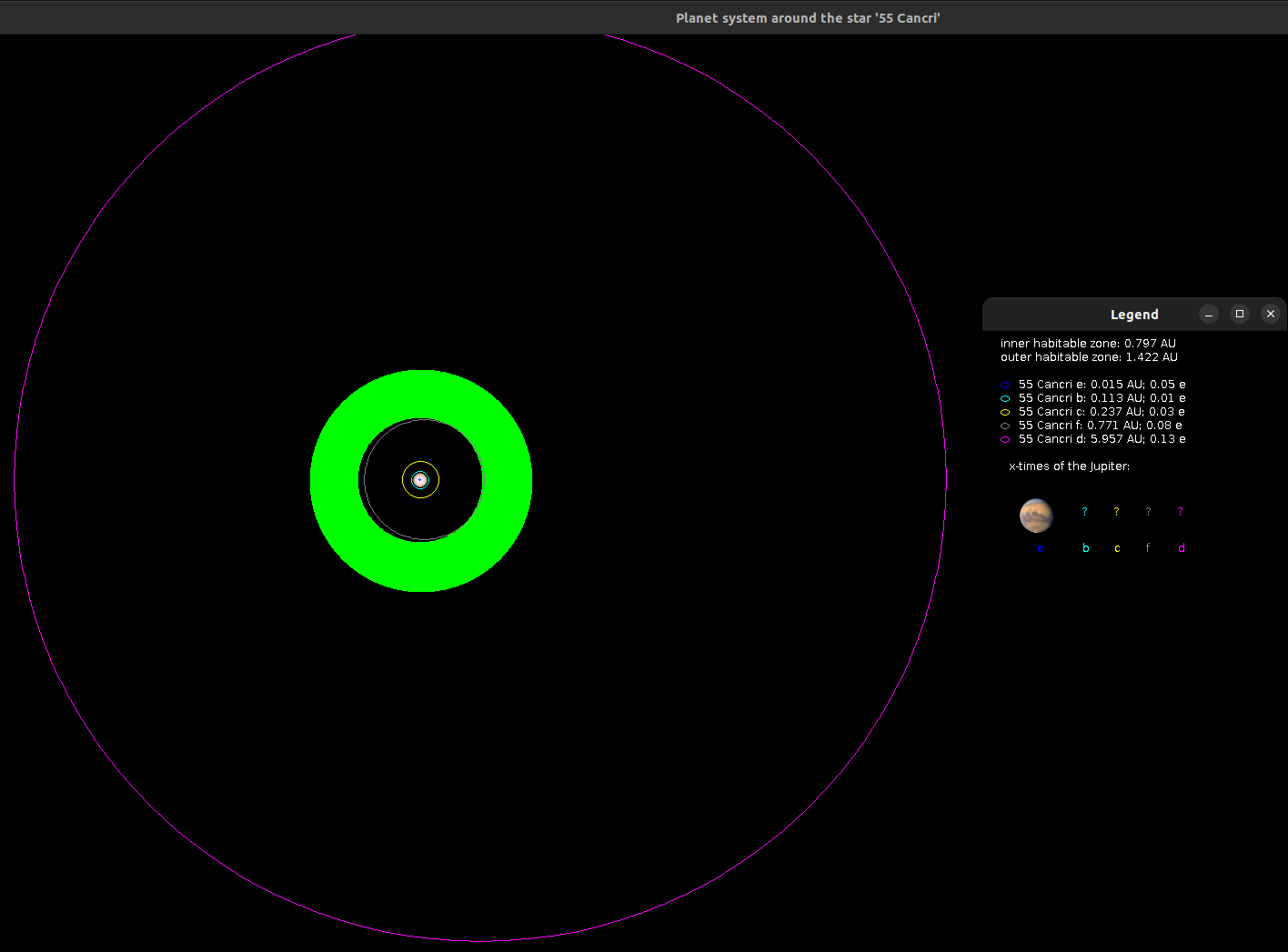
Orbital simulation of the famous multi-planet system 55 Cancri and its orbital dynamics.
10. Kepler Field Star Map
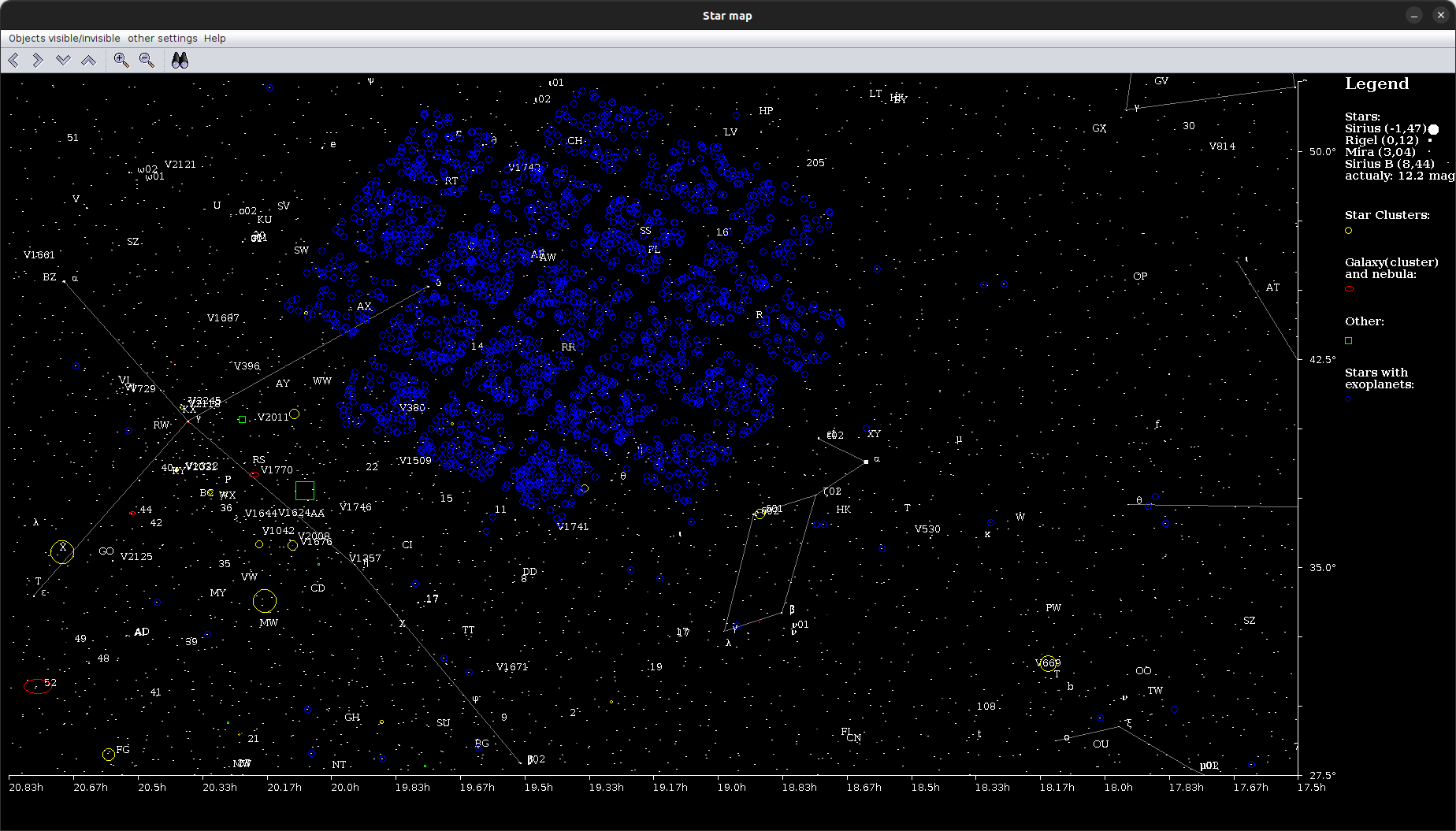
Interactive sky chart detailing the Kepler primary field in Cygnus / Lyra constellations.
System Requirements
Dual-Core CPU, min. 2.5 GB RAM
950 MB disk space (+ custom user database entries)
Windows, Linux, macOS (Java 21 JRE+FX included or external)